Detect the failure
A vision system, checkweigher, metal detector, X-ray, code reader, leak tester, filler, labeller or PLC creates a defined fail output.
System guide
How a production line turns an inspection fail signal into controlled, verified product removal without losing product identity.
 Detection • Tracking • Rejection • Verification
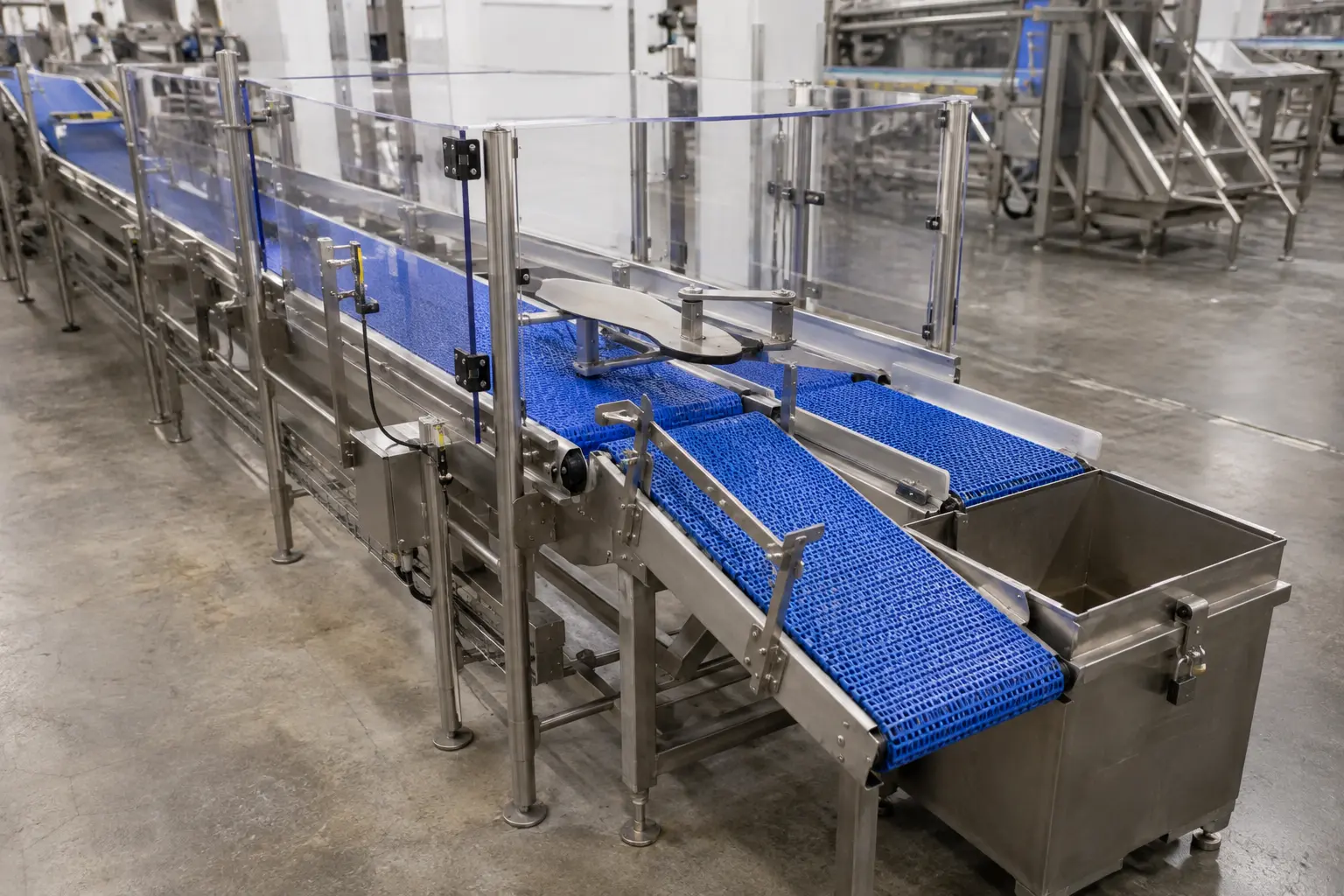
An automatic reject conveyor system receives a fail decision from inspection or process equipment, tracks the correct product to a reject point, removes it from accepted production and, where required, confirms that removal independently.
The reject device is only one part of that sequence. Reliable performance depends on stable product presentation, accurate timing, sufficient conveyor length, a suitable removal path, secure containment, guarding and a defined response when anything does not happen as expected.
A complete system may be supplied as a new conveyor module or retrofitted to an existing customer conveyor when its construction, controls and available space are suitable.
Specify the sequence from the original decision to the final fault response. This prevents a fast reject device from masking weak tracking or poor containment.
A vision system, checkweigher, metal detector, X-ray, code reader, leak tester, filler, labeller or PLC creates a defined fail output.
Fixed timing can suit stable-speed lines. Encoder-based tracking follows conveyor movement when speed changes or the reject point is further downstream.
An air blast, pusher, sweep arm, diverter, drop flap or retracting belt moves the failed item away from accepted production.
The rejected item enters a chute, locked bin, reject lane, rework conveyor or another defined destination suited to the quality process.
An independent sensor can confirm the expected reject and raise an alarm or stop the line if confirmation is missing.
Low air pressure, a full bin, open access, sensor faults or product jams need an agreed alarm, line-stop and reset response.
Mass alone does not determine the reject method. Footprint, centre of gravity, surface friction, rigidity, open tops, liquid movement and pack fragility all affect how a product accelerates and where it lands.
The design needs minimum and maximum speed, realistic product pitch and any accumulation. Closely spaced products create a different problem from single products moving quickly: the mechanism must reject the failed item without disturbing adjacent accepted items.
Guide rails, belt gaps, transfers, curves, side frames and guarding can restrict both the sensing position and the reject path. A short line video and a dimensioned layout are often more useful than nominal conveyor width alone.
The quality team should define what happens after reject-not-confirmed, full-bin, low-air or access-open conditions. The controls can then implement the agreed line stop, alarm, product-clearance and authorised reset sequence.
Useful when more reject length, controlled transfers, hygienic construction, integrated guarding or a dedicated control panel are required.
Suitable where the conveyor is mechanically sound and has enough space for sensors, a reject mechanism, containment and safe access.
In both cases, agree the pass/fail signal, tracking reference, safety responsibilities, upstream and downstream stops, and commissioning tests.
The correct design depends on the actual product range and production behaviour.
It is the complete sequence that receives a fail signal, tracks the correct product, removes it from the accepted flow and, where specified, confirms the removal independently.
Often it can. We first review conveyor construction, usable length, product spacing, control interfaces, guarding and the path into a suitable reject destination.
Common triggers include vision inspection, checkweighers, metal detectors, X-ray inspection, code readers, leak detection, fillers, labellers and PLC process signals.
Not every application has the same risk. The customer’s quality process and risk assessment should determine whether independent reject confirmation, bin monitoring, access supervision and line-stop responses are required.
Planning a new system or retrofit?
Send a short line video, product dimensions, throughput and the available inspection signal. We will help define a practical next step.
Share the product, throughput, inspection trigger and available conveyor space. We’ll help identify a practical next step.
Request a line review →01865 416657