Where is the failed product?
A product sensor and stable delay—or an encoder tied to conveyor movement—maintains identity between inspection and rejection.
Fail-safe engineering guide
Prove the expected product left accepted production, supervise the conditions that make rejection possible and define what the line does when the sequence fails.
 Track • Act • Confirm • Respond
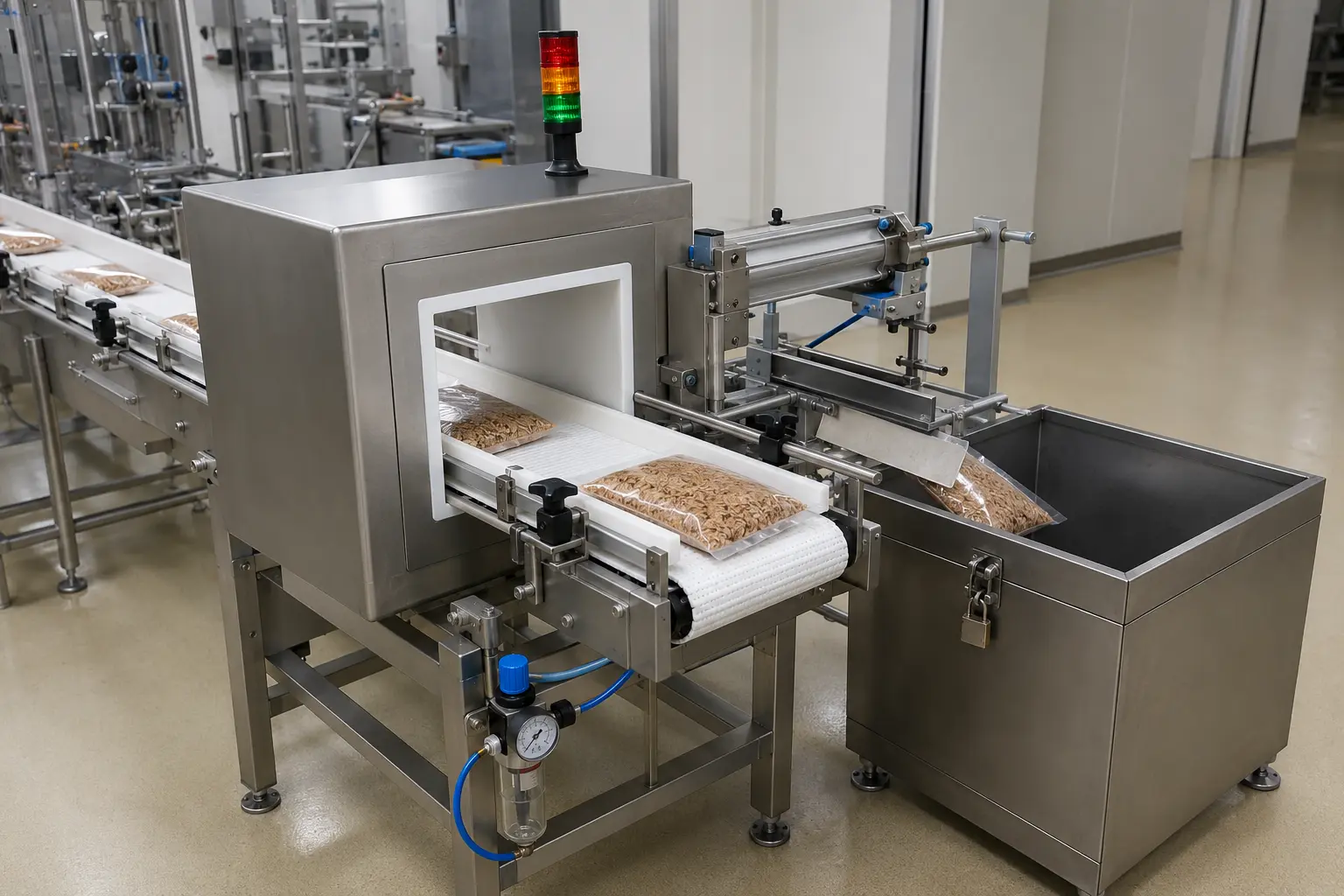
Reject verification independently confirms that the expected failed product reached the reject chute, lane or bin. If the confirmation does not arrive within the calculated window, the controls can raise a fault and stop the line.
Commanding a reject actuator is not the same as proving product removal. A cylinder-position switch may show that a pusher moved, yet it does not prove that the failed pack reached secure containment. A reject confirmation sensor closes that gap by observing the outcome after the product leaves the accepted path.
The required monitoring level should be set by the customer’s risk assessment and quality process. Higher-risk applications may combine product tracking, actuator feedback, reject confirmation, bin-full sensing, access supervision and line-stop logic.
Clear sensor roles make fault finding and challenge testing more meaningful. One device should not be assumed to prove every part of the sequence.
A product sensor and stable delay—or an encoder tied to conveyor movement—maintains identity between inspection and rejection.
Position feedback can confirm a pusher, flap or diverter reached and returned from its commanded position on time.
An independent sensor detects the expected item in the reject chute, lane or bin within the correct time window.
A bin-full sensor warns before rejected product can build up, obstruct the chute or compromise the next reject.
A door or bin-present switch can supervise access and prevent normal running when the required containment is unavailable.
Low-air-pressure monitoring can stop a pneumatic system before pressure falls below the level needed for a dependable stroke or blast.
The inspection machine provides a fail signal while a product reference—usually a photocell event or known inspection position—identifies the physical item.
For stable-speed, short-distance applications, a validated time delay may be sufficient. If speed changes, an encoder can measure conveyor movement so the rejection window follows distance rather than elapsed time.
The controls open a time or encoder window in which the separate reject sensor should see the failed item. The window needs to tolerate normal product variation without becoming so wide that the next item could be mistaken for the reject.
A valid confirmation completes the event. No confirmation, an unexpected confirmation or conflicting sensor states should lead to the agreed response: warning, line stop, hold state or another controlled action.
The system should make the fault visible and support a clear recovery process. Reset permissions, product clearance and any required inspection challenge should be agreed with production and quality teams.
Alarm, stop the conveyor and apply the customer’s procedure for products between the inspection point and confirmed containment.
Stop before the system attempts another pneumatic reject or before the reject destination can no longer receive product safely.
Prevent normal running when required reject security or containment is unavailable, subject to the agreed safety and quality architecture.
Commissioning should test normal rejection and credible fault conditions. The exact protocol depends on the application, but a useful plan can include:
Testing proves the configured operating envelope; it does not remove the need for routine challenge procedures defined by the site’s quality system.
Monitoring should be proportionate to risk and matched to a defined production response.
It is an independent sensor positioned to detect the product after it leaves the accepted production path. It proves a different condition from an actuator-position switch.
The controls can alarm and stop the line, retain the fault and support the site’s product-clearance procedure. The exact response must be agreed during specification.
It detects when rejected product reaches a defined level so the system can warn or stop before containment becomes obstructed or another reject cannot enter reliably.
No. Stable-speed applications may use validated timing. Encoder tracking is valuable where conveyor speed changes or physical distance must remain the tracking reference.
Define the intended fault response
Share your quality risk, inspection trigger and existing line controls. We will help structure the reject and verification sequence.
Share the product, throughput, inspection trigger and available conveyor space. We’ll help identify a practical next step.
Request a line review →01865 416657