Metal detector reject systems
Track and remove products that trigger a metal detector, with secure containment and monitoring options.
Food production engineering
Automatic product rejection, secure containment and monitored fault responses configured around the real pack, inspection point, hygiene environment and site quality process.
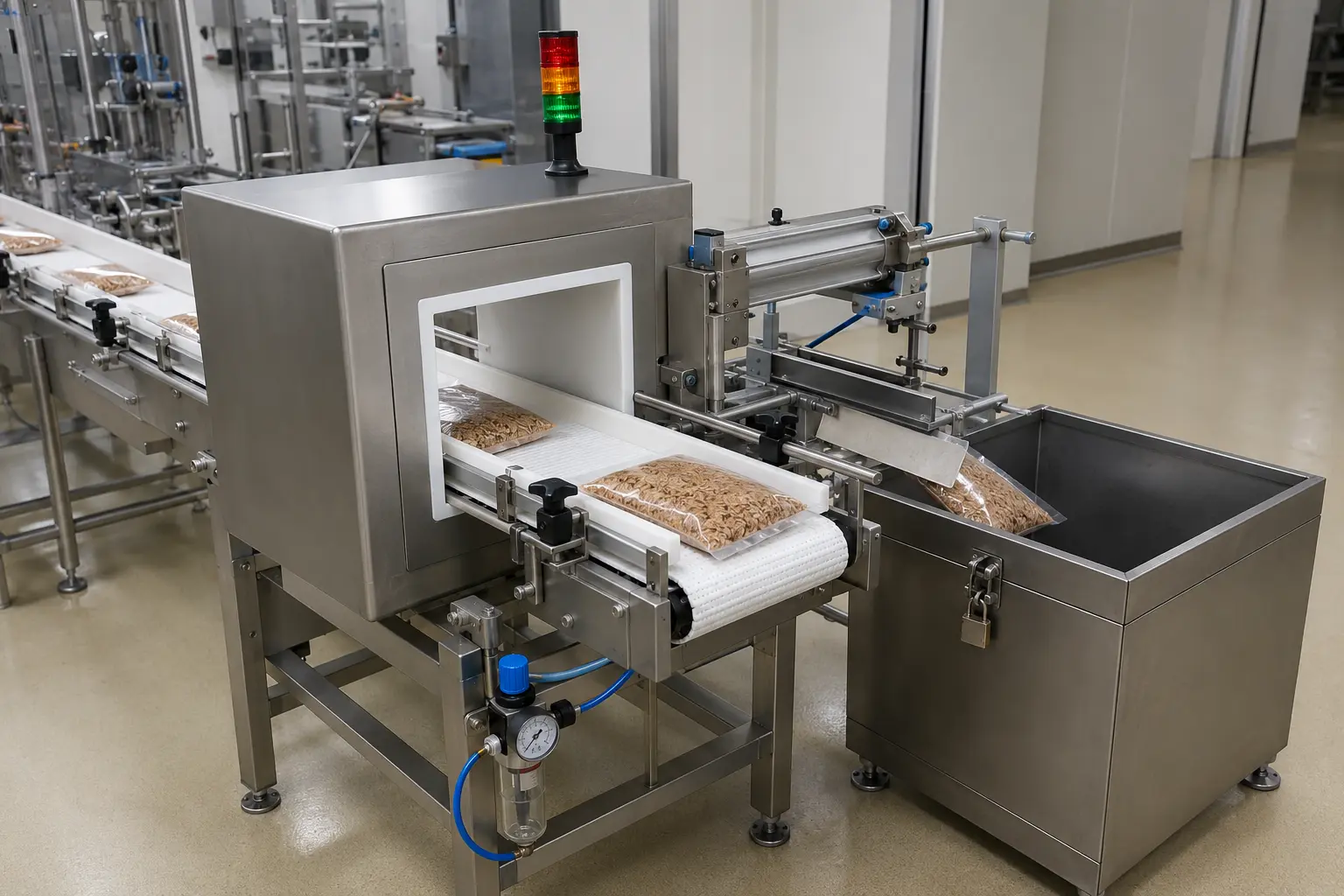 Hygienic handling • Secure containment
A food and beverage reject system tracks a failed pack from an inspection or process decision, removes it from accepted production and directs it into secure containment or a controlled reject lane. Monitoring can confirm the reject and stop the line when required conditions are not met.
The design must suit both the product and the production environment. Open or unstable packs behave differently from sealed cartons; wet cleaning changes material and enclosure requirements; and higher-risk inspection points may need independent reject confirmation, locked containment and supervised access.
Equipment features are agreed against the manufacturer’s hazard analysis, site quality system and customer requirements. A reject device alone does not create compliance with BRCGS, retailer or other certification requirements.
We define the electrical signal, tracking reference, product window and fault response with the relevant inspection-equipment supplier and the customer team.
Track and remove products that trigger a metal detector, with secure containment and monitoring options.
Reject contaminated, damaged or incomplete packs after an X-ray inspection decision.
Remove underweight and overweight packs while protecting adjacent accepted production at the specified pitch.
Reject missing, unreadable or incorrect date codes, barcodes, labels, caps, closures and visual features.
Remove packs that fail pressure, vacuum, seal or other integrity tests without spreading leaks into accepted production.
Use machine or PLC signals to reject no-fill, underfill, overfill, missing-label and process-fault products downstream.
Specify the actual cleaning method, chemicals, temperature and hygiene zone. Stainless-steel frames, accessible geometry, suitable belt materials, protected sensors and enclosure ratings can then be selected for the intended environment rather than assumed from the word “food”.
Trays, pouches, jars, bottles, cartons and cases all require different acceleration and containment. The reject method must work across weight, fill level, surface friction and line-speed variation without destabilising adjacent accepted packs.
A lockable bin, guarded chute or supervised reject lane can restrict access to failed product. Bin-present and bin-full sensors can prevent normal running when the required containment is unavailable.
An independent reject confirmation sensor can prove the expected pack entered the reject area. Low-air pressure, reject-not-confirmed, access-open, full-bin and device-position faults can be linked to the site’s agreed alarm and line-stop philosophy.
Acceptance tests should cover the product and speed envelope, consecutive rejects and fitted monitoring inputs. The site quality team should also define routine challenge frequency, test pieces where applicable, record keeping and recovery after a failed challenge.
Materials, belt choice, access and geometry selected around product contact, spillage, washdown and the site cleaning method.
Secure bins or supervised lanes can support controlled handling of failed products and authorised removal.
Product tracking, confirmation, bin-full, low-air and access inputs can create defined warnings and line stops.
Adjustable guides, change parts, recipes and format-specific testing support controlled production changes.
Agree acceptance criteria, challenge tests, operator guidance, maintenance information and project records before delivery.
Define interfaces with the inspection supplier, PLC, safety system and upstream or downstream machines.
Final requirements are confirmed from the product, hazard analysis, site procedure and production environment.
Common triggers include metal detectors, X-ray inspection systems, checkweighers, machine vision, barcode and date-code inspection, leak testing, filling equipment and labelling machines.
Yes. Lockable bins, bin-present sensing, bin-full monitoring and supervised access can be included where required by the site risk assessment and quality process.
No single reject device makes a line compliant. Equipment and monitoring must sit within the manufacturer’s wider hazard analysis, quality system, site procedures and applicable customer or certification requirements.
Often, yes. We review hygienic construction, cleaning, available reject length, product spacing, containment, guarding and the inspection or PLC output before confirming feasibility.
Start with the real production line
We will review product handling, inspection signals, reject containment and monitoring as one production sequence.
Share the product, throughput, inspection trigger and available conveyor space. We’ll help identify a practical next step.
Request a line review →01865 416657